

Adapt
Balestra's Sixth Edition

Welcome to the sixth edition of Balestra! With this edition we’re now well into the second year of Balestra and are continuing to grow and evolve. Balestra is now read in 28 different countries and is continuing to grow in volume and variety of submitters and readers. A massive thanks to everyone who’s become part of the Balestra community. This edition had a mix of visual art, prose, and poetry from fourteen different artists. If you enjoy this edition consider buying a copy of our first edition anthology or picking up a piece of Balestra merchandise.
The artists for this edition are Richard Collins, a prolific educator, widely published writer, and Abbott; Philip Athans, a poet who’s worked with legendary companies such as Wizards of the Coast; Cate Petty, an American visual artist bringing Balestra an array of beautiful blues; Jennifer Eagleton, a Hong Kong based writer exploring what it is to be a bug; Jason Ryberg, a poet whose work weaves along the page with charm both literary and visual; Michael Roque, a poet exploring the untastable nature of memories; Paul Hedges, an artist walking the non-existent line between visual art and visual poetry; Alaina Hammond, a prolific playwright asking and answering one essential question; Lauren Paré, a poet offering us four wildly different forms of fabulously rich poetry; Allan Johnston, a wildly accomplished poet and scholar giving Balestra new look at ancient tales; Cynthia Yatchman, a visual artist bringing abstract and vibrant renditions of the natural world; Doug Stoiber, a writer taking us all on a perilous and unpredictable journey; Souad Zakarani, a Moroccan writer, poet & translator writing political poetry of the utmost importance.
We encourage you to comment your thoughts, share your favourite pieces, subscribe for more, and most importantly, enjoy!
Richard Collins
Richard Collins (he/him) has taught at universities in the U.S., Romania, Bulgaria, and Wales. His books include John Fante: A Literary Portrait (Guernica Editions, 2000), No Fear Zen (Hohm Press, 2015), In Search of the Hermaphrodite (Tough Poets Press, 2024), Stone Nest: Poems (Shanti Arts, 2025), and Cartoons for the Chaos: Poems 1975-2025 (Shanti Arts, forthcoming, 2026). Special features and nominations (Pushcart, Best of the Net, Best Spiritual Literature) appear in Clockhouse, Philly Chapbook Review, Shō Poetry Journal, Willows Wept, and The Seventh Quarry. He is abbot of the New Orleans Zen Temple and lives in Sewanee, Tennessee.
Nightwatchman Reads Beckett on Proust
                  To die fighting was the perfect antithesis of his whole
                  practice, faith, and intention.
                             —Samuel Beckett, Murphy

As night watchman on the graveyard shift
the aging student reads Beckett and writes about Time’s

Trilogy—perpetuum mobile of all desire—
as Murphy plays chess with inmates at the asylum.

Every hour at “unpredictable intervals” he lifts
his head to scan the lot, then makes his rounds among

gray shipping containers in elephantine slumber
waiting for their drivers to whip them awake.

His flashlight illuminates the opaque Oregon drizzle,
Northwest coastal fog thickening toward an even obscurer

ledge of dawn. Should he meet some thief or hijacker
in the mist, how, he wonders, would he greet them?

With a meek whistle and a shout, or a friendly bark
of mutual ambivalence about their respective jobs?

After all, he bears no grudge, much less arms
and their roles are as perfunctory as their pay.

As night grows darker he looks forward to the coming day
and returns to the ill-lit ill-heated guard shack

because he cares (above all) what Beckett has to say,
curious what clever move Murphy has made behind his back

because only in books does he find what he’s looking for:
sanity in the asylum, inmates who still get the rules of the game.
Disappointment Point
                “I’m not a—how do you say it—a ‘country dumpling’.”
                            —Willem de Kooning

We searched for it for hours along the trail
to Point Disappointment

Wondering who named it that and why—
in the end we couldn’t find it but that seems right

I was preoccupied thinking of all those great artists
whose biographies I’d been reading

Gamblers and masochists, suicides, drunks and womanizers
Freud and Bacon, Gorky, Pollock and de Kooning

Who painted with prodigious brushes, like careless gods
industriously or wildly, obsessively, unfailingly

Who fathered children flailingly, who flung
their seed money wide and far at the bars, casinos, horses

And squandered what they had in life for some intangible
that might come their way in their pursuit of Art

Only to reach the city limits in whatever demon form
—drink or damsels or dementia—to the point of disappointment

Like late de Kooning when he reached Louse Point
after hitting the top of his game and the bottom of too many bottles

Before coming to the country and some realization
of “form-obliterating radiance” at the Springs

No “country-dumpling” he, claimed the king of fleshy abstraction
dead drunk (as the cliché) in a gutter in the Bowery

One gets the feeling they sought it out, these self-
deromanticizing geniuses, being down and out and then

Finding themselves in the grip of an abyss, at the end
of a rope in a barn, or the trunk of a tree in the road

Fleeing not only wealth, reputation, and admirers
but the gifts of wives, mistresses, and daughters

And bidding goodbye to the quiet monotony
of too much adulation and their “Loveds”

After all, what is the point of disappointment
if you find it while in search of it?

Isn’t that the point—to be surprised
by disappointment when it finds you

Not at the tail end of a long search when you’re tired
but early on when youth has the stamina to stomach it

Better to be surprised (even if you can’t be pleased)
by attaining the goal of no goal

In the art world the point, it seems, is to get beyond
the disappointments of success

Now I think I know why they named it so:
not finding disappointment is the point.Philip Athans
Editor and author Philip Athans has been the driving force behind varied media including Alternative fiction & poetry magazine and Wizards of the Coast. He lives and works in the Pacific Northwest.
It’s Not That I’ve Been Hurt
I feel the heft of my life in my hands
The whistle of years going by in my ears
A bitter taste in my mouth might be disappointment
That might be me that smells like that
But my left eye is mostly fine

It’s not that I’ve been hurt
It’s that I remember being hurt
and hardly anything elseFind More of Philip’s Work at:
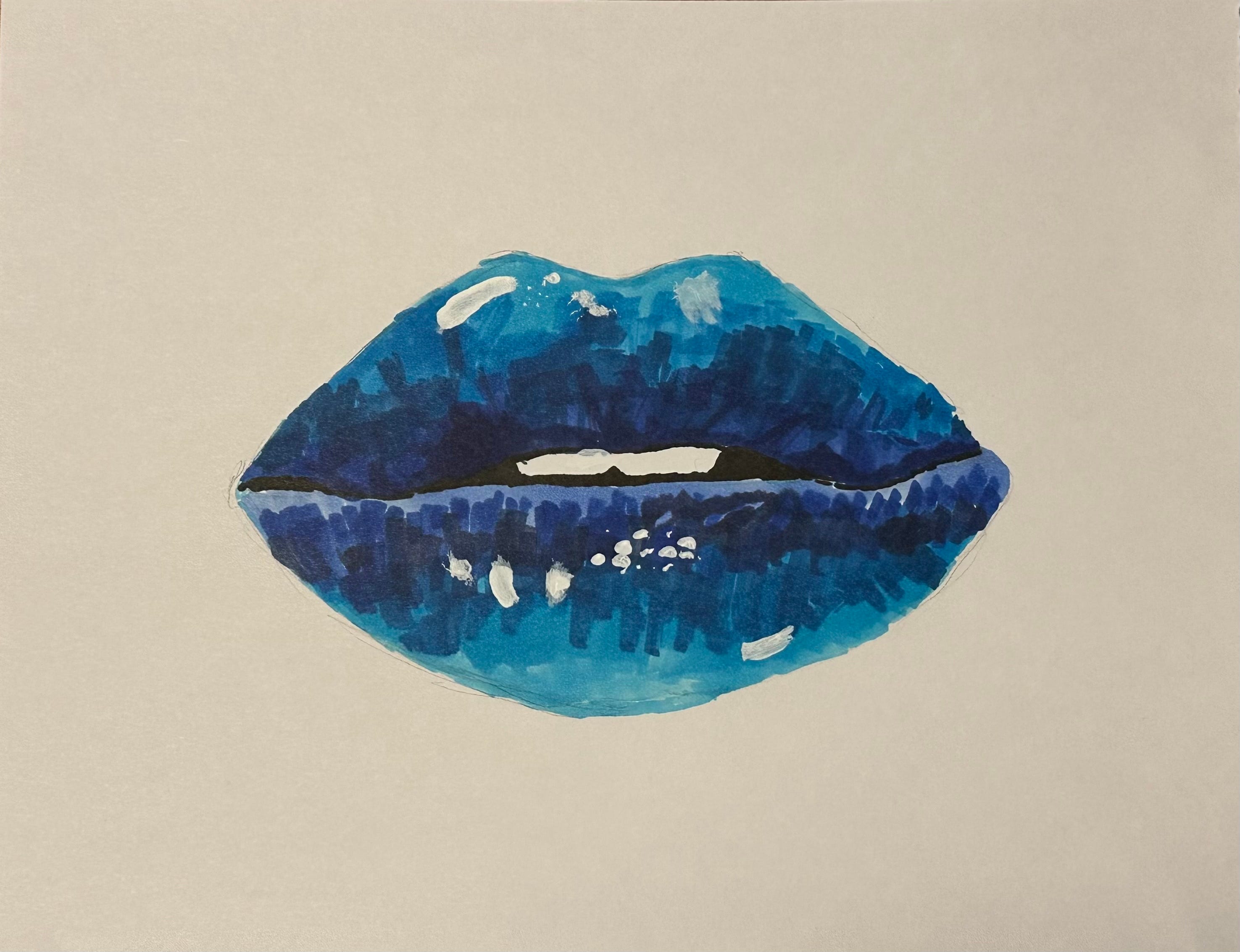
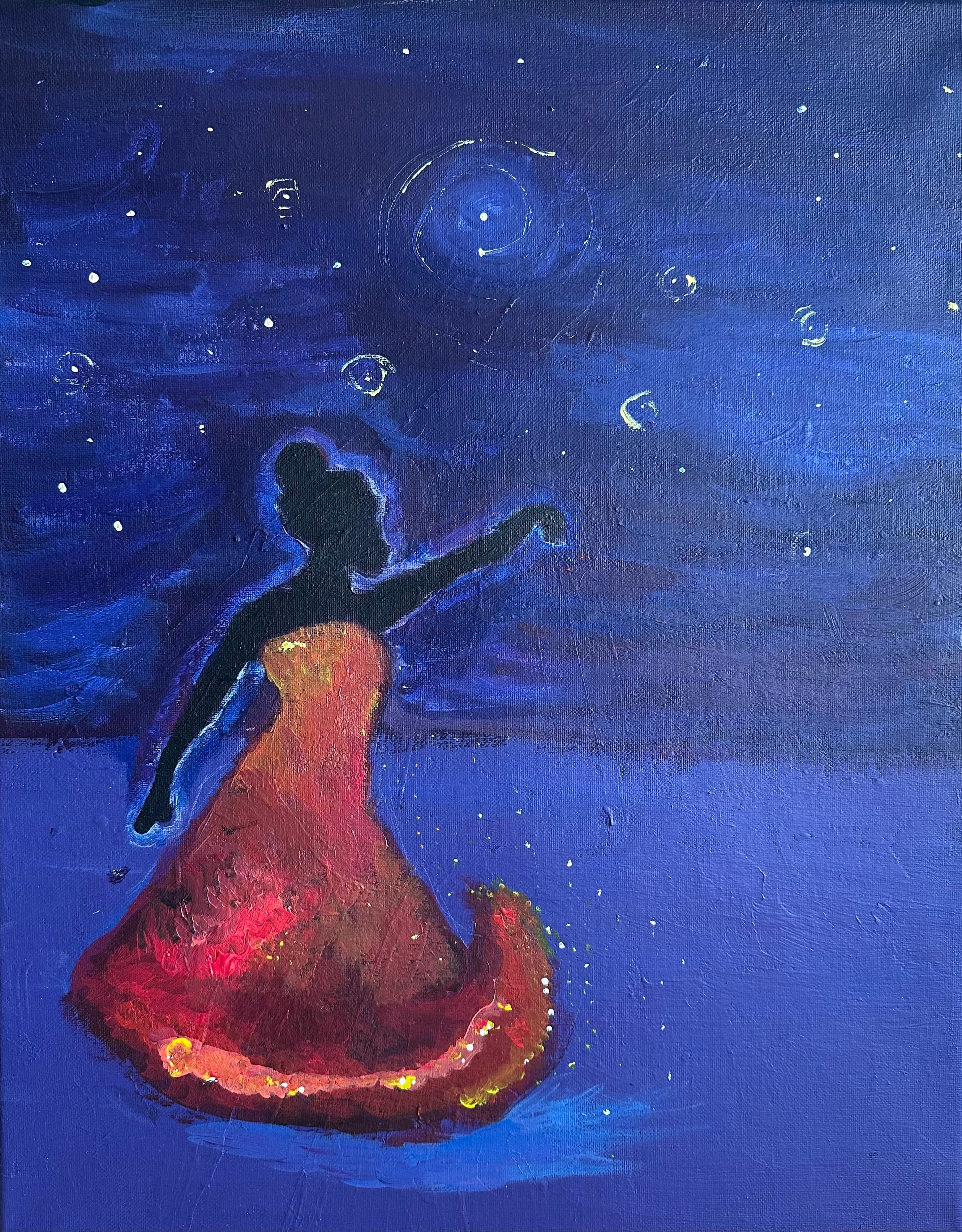
Cate Petty
Cate Petty (she/her) is a visual artist in Oak Park, Illinois. Her first published work is forthcoming in the Up North Literary Journal.
Anticipation
Starlight Dancer
Jennifer Eagleton
Jennifer Eagleton (she/her), a Hong Kong resident since October 1997, is a close observer of Hong Kong society, culture, and politics. Jennifer has written essays, reviews, opinion pieces, and poetry for publications such as Hong Kong Free Press, Voice & Verse, Cha – An Asian Literary Journal, Mekong Review, and Education about Asia. Jennifer, has a PhD in applied linguistics, is a past president of the Hong Kong Women in Publishing Society and currently teaches stylistics and discourse analysis at Hong Kong Metropolitan University and is a research assistant at the University of Hong Kong.
Kafka Conscience
“I’m sorry, but you filled out the form incorrectly. You have given us wrong
information, so we have to cancel your pension, so you have to pay back the money
already received.

“I just made a simple mistake,” said the middle-aged lady, tears welling up in her eyes.
“I have to take care of my disabled son full time; I need the Carer’s Pension.”

“Sorry, but this is the rule; you have to fill out the form again, wait six weeks, have
another interview before you can get any money.”

The lady standing behind her in the queue said rather loudly “bloodsucker”; she told
the man behind her about what had happened, and he told the woman behind him.
Soon the queue became energized. And the chant went up: “blood sucker”, “blood
sucker”, “blood sucker”, “blood sucker”, “blood sucker”, “blood sucker”, “blood
sucker”, “blood sucker” …

***
I wake up sweating and in a panic.

But something does not seem right. I feel a strange sensation in my body. I feel my
limbs: they are long, slender, rather hairy. I seem to have more than two of them! I
reach up and feel two protuberances growing out of my head. They feel like long thin
wire antennae. I bend them and they bounce back like a spring. I reach down and
touch my nose, which seems beak-like, a proboscis, three to four times longer than
my head. I have two scaled structures like gossamer wings folded underneath me.

Too weird. Obviously, I am in that half-awake, half-dreamlike state, that you
sometimes get while hungover. I decide to continue lying down for a while; it’s
Saturday so I don’t have to go to work. It was Jack’s retirement party from the Civil
Service yesterday. I was feeling a little upset about work myself, as I normally don’t
drink much.

My head clears a little, but my body still feels odd. I touch myself, but everything still
feels different.

The air-con was off I remember, so I had opened the window when I got home last
night. It’s summer and the steaming humidity is something usually unbearable, but I
don’t seem to mind it now. I’m starting to feel a little peckish which is always a good
sign after a hangover. I’m a bit wobbly as I try to stand upright, but I can’t on my two
thin legs, but I seem to have six of them! Crawling seems best, but I get the gist of
using them rather quickly.

I go to look in the mirror, but my eyesight seems worse than normal. I just see a
strange shape; I can’t begin to process what I am seeing. Where are my glasses? The
sight of me in the morning is too disturbing at the best of times, so I usually avoid
mirrors till after I’ve had my breakfast and a shower. But this seems ridiculous. This
morning, I have the sudden urge to go out. I can’t seem to be able to dress myself. So
weird.

Am I still dreaming? I’m not sure – everything feels so real, 3D even, but so bizarre it
cannot be real. Anyway, let’s go with the dream to see how it will end.

I appear to flap my wings and levitate out of the open window. Hovering, I see a
family down the way by the lake, with picnic basket, checked blanket, sausages sizzling on the BBQ. Looks like Dad, Mum, the two kids enjoying a mid-summer Saturday morning outing. An elderly lady, probably Grandma, was off in the distance picking wildflowers.

I feel like joining the family. I can smell so many good aromas coming from their
direction. I may just take myself to that park bench over there and watch them. I flap
my wings till I get near the park bench on the other side of the lake from the family,
near where Grandma is picking wildflowers. I hover around her for a while.

One of the kids, a little boy, stands up, looks around and wildly points in my
direction. “Look! Look! A monster is heading towards Grandma! It looks like a giant
insect!

Dad says, “What a lively imagination you have!”

I gather speed and descend rapidly, targeting the naked flesh on Grandma’s arm.

Grandma looks at me and screams, but my nose, or rather proboscis, like the perfectly
designed hypodermic needle it is, sinks deeply into the old lady’s sweet-smelling flesh.
My two maxillae quickly penetrate her skin with their saw-toothed edges, and I inject
saliva into the wound along with a cocktail of anti-coagulant substances, so I can draw
up a feast of delicious blood. Yum! Yum! I take my time at this feast.

Dad comes running over at Grannie’s screams wildly wielding his BBQ utensils in
both hands.

This red stuff is intoxicating, I slow down a bit, to let the tangy taste of iron resonate
on my palate. I raise my head and see Dad lift his arms and…

SPLAT…

I wake with a start, sweating. Everything seems hazy, but my eyes clear and I see that
I am in my bed, sheets flung around wildly. I have the normal number of arms and
legs, no antennae, no wings, while my nose is its normal aquiline shape.

Just a nightmare.

I feel chastened and relieved. I get up and head towards the kitchen hearing the
rattling sound of pots and pans. Emma must be cooking breakfast – the
mouthwatering smell of hangover food of sausages, bacon and beans wafts towards
me.

“Emma, darling! I call out as I walk into the kitchen and see…

A large mosquito cooking breakfast and beside her a smaller mosquito eating a bowl
of cereal. “Eat up your oatmeal, Jamie, your dad…” she said in a whiny voice.
Find More of Jennifer’s Work at:
How to Select a Chief Executive and other Metaphors of Hong Kong Politics
Jason Ryberg
Jason Ryberg lives part-time in Kansas City, MO
with a rooster named Little Red and a Billy-goat named
Giuseppe, and part-time somewhere in the Ozarks,
near the Gasconade River, where there are also many
strange and wonderful woodland critters.
Straw Men Shouldn’t Play With Matches
I’ve heard that straw men
shouldn’t play with matches, that
quarters are the new
      dimes, and long is the night spent
      staring up at the ceiling.
Back to the Future / Forward to the Past
Here we are going
backwards, again, to our own
individual

and collective fates
and futures like railway lines
that no matter where

or when we find our-
selves at any given time
along them we are

somehow always just
behind or just ahead of
schedule and no one

ever there to greet
us and very possibly
no place to get off.
Lurid and Tasteless (Tanka)
To find out later,
after years of deluding
oneself that they were,
   merely, the lowly, humble
   projectionist of all these

absurdly lurid
and tasteless fantasies, that
all along, they were
   also the writer, director
   and star, must have been crushing.
Hot Wired
It
seems
as if
we’ve never
quite abandoned our
belief in alchemy (or some-
thing almost like it) even though we may never be
able to always properly define what
    it means, exactly, when caught off-guard, and
apparently it’s widely held by many of our
fellow travelers on Spaceship
Earth that poets are
directly
hot-wired
some-
how
in-
to
the grand
motherboard
of the universe
and allegedly possess the
gift of prophecy as well as the ability
to divine deep meaning from wild circumstance,
    which is, of course, simply ridiculous.
New Moon
How many drinks do
we have to offer and how
many promises
    do we have to make to the
new moon to finally get
them to completely disrobe?Michael Roque
Born and raised in Los Angeles, Michael Roque discovered his passion for poetry and prose among friends on the bleachers of Pasadena City College. Now residing in the Middle East, he draws inspiration from the bustling, tumultuous life around him. His work has appeared in literary magazines and anthologies worldwide, including award-winning publications such as North Dakota Quarterly, The Queen’s Review, The Roanoke Rambler, Poetry Super Highway, and many others.
Something the Tongue Can’t Untaste
Ice cream on a cone throne—
YOU, the solid scoop of sweetness,
picked, purchased, carried off
from freezer to sunshine spotlight
to bask in an unfamiliar flow
Drip
 Drop
  DRIPPED—
till flavors ran over fingers,
trailed to floors
where footsteps distanced droplets from the whole.

Splat by splat—
YOU, the once solid scoop wept,
caved into your cone,
drizzling a creamy richness over the rim,
no licks could save.
Drip
 Drop
  DRIPPED—
till only dry wafer remained,
sticking, smelling
of memories tongues can never untaste.
Find More of Michael’s Work at:
Paul Hedges
Paul Hedges (he/him) is a poet and writer who grew up in the village of Fruitport, Michigan, and graduated from Michigan State University with a degree in Creative Writing. He is now a part of a few writing groups in the Lansing area and can trusted to provide honest and objective feedback on all poems, especially prose poems. Aside from writing, he enjoys cooking anything so long as it goes with rice, mountain biking very carefully, and jamming out on his guitar.
Attention Florists
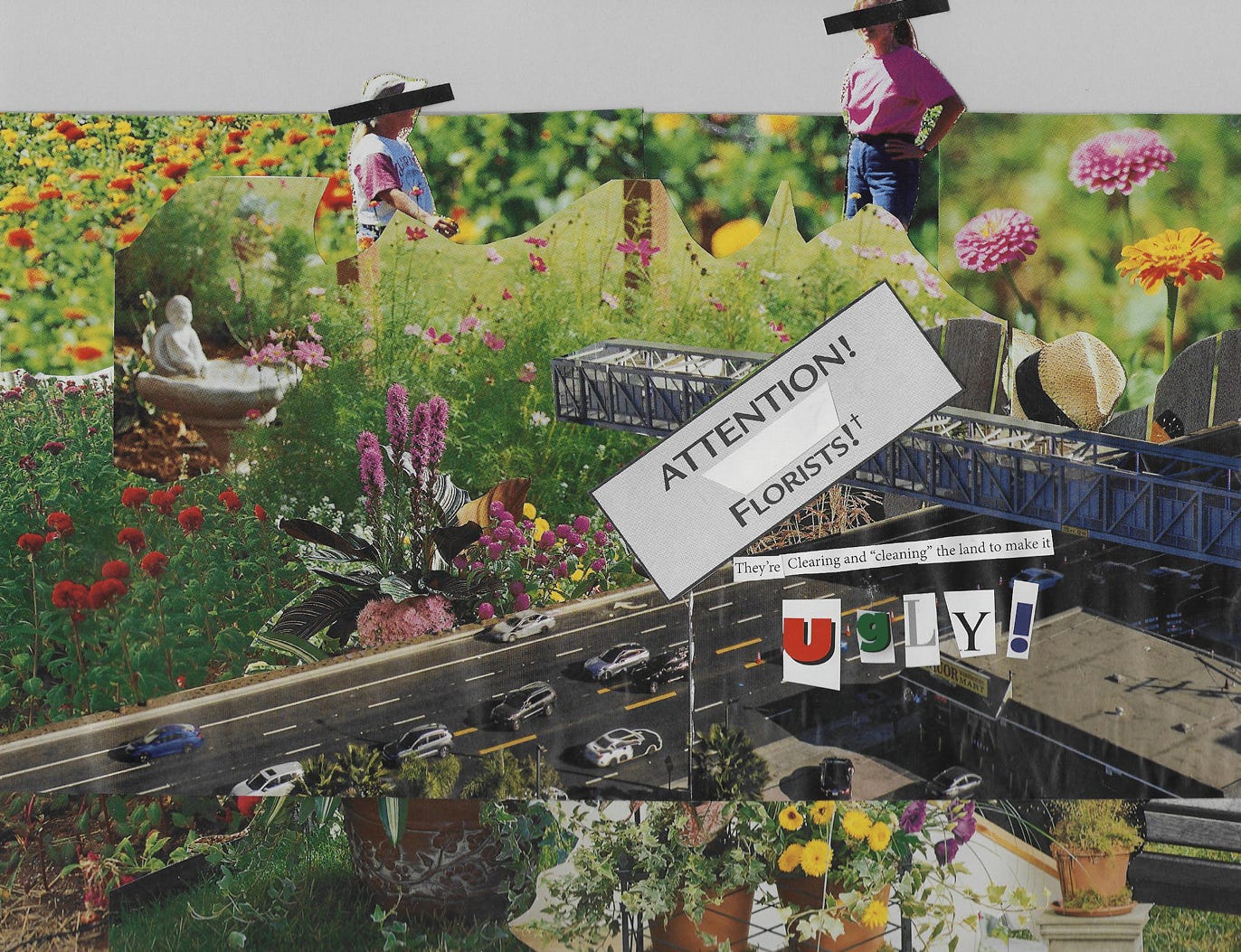
You Are Not A Person
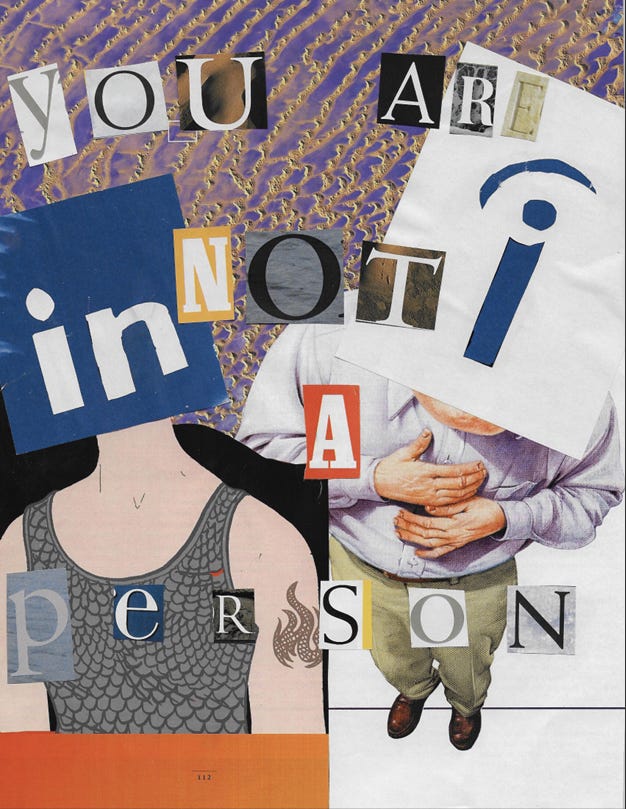
Cover 2
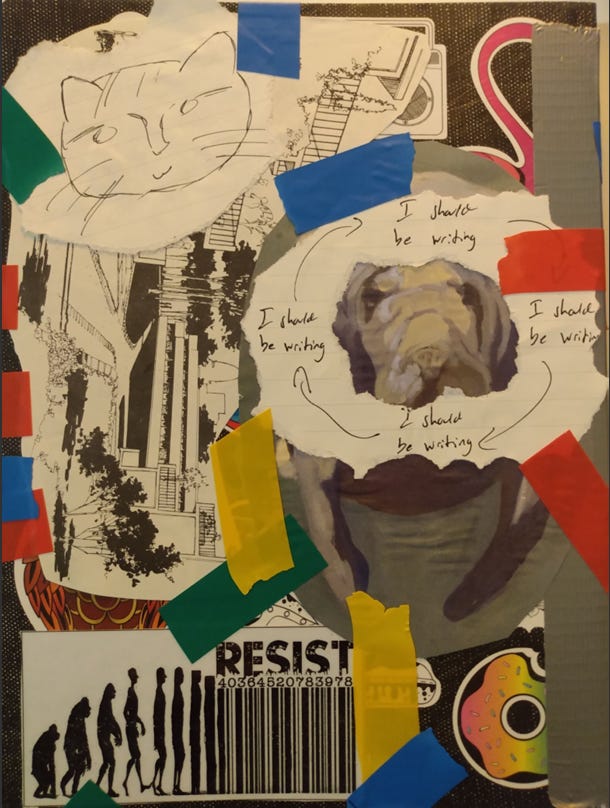
Alaina Hammond
Alaina Hammond is a poet, playwright, fiction writer, and visual artist. Her poems, plays, short stories, nonfiction, paintings, drawings and photographs have been published both online and in print. Over fifty of Alaina’s original plays have been produced off-off Broadway. Her novelette “Jillian, Formerly Known as Frog Girl” was published by Bottlecap Press. Four of her flash fiction stories (“Jane Passes The Bar Exam,” “To Serve In Retail Hell,” “As Numb As I Am” and “Why I Said What I Said To The Bartender”) were nominated for the Pushcart Prize, all in 2025. Additionally, her microfiction pieces “Muffin Or Something” and “Wigless” were both Best Microfiction 2026 nominees.
This Is Why
Mariann and Victor existed in that nebulous space between acquaintance and friend. They got along very well, but had never spoken outside of school.
The minute that history class ended, Mariann asked Victor if she could talk to him. Just for a minute, she said. They went out into the hallway, in a corner away from the moving masses.
“Sweetheart, what’s up?” He put his hand on the small of her back, in an attempt to be
gentlemanly and reassuring. She was obviously in distress. Ugh, teenage girls were so high maintenance! Thank god he wasn’t trying to sleep with them. He felt bad for straight boys, honestly.
“Um. You can say no. Obviously I know this is last minute. My sister’s
wedding is tomorrow. It’s like, an hour away. And I don’t have a way of getting there myself. I was wondering if you could drive me? If you want to attend the wedding as my guest, I’d love that, but there’s no pressure on you to stay. If you’d rather just drop me off, do your own thing, and pick me up a few hours later, that’s fine too. Anyway. As I said, I know it’s last minute. Oh and of course I’ll pay for gas and everything.”
“I’ll have to ask my parents, but that’s probably doable. Um. Why aren’t your parents
driving you, though?”
“Well my sister’s marrying a woman and they’re not…like…thrilled? But they said I can
go. So you know. There’s that.”
“Ah. I see. Yes. I will ask my parents, and confirm with you tonight.”
She hugged him, quickly, then hurried away.

“Why can’t her own parents drive her? Are they not attending?” Victor’s mother Clara
asked. Not unreasonably.
“Her sister’s marrying a woman and apparently they’re not down with that.”
“Well that’s just ridiculous! Dad and I will never skip any important milestone of yours.”
“Yeah yeah, do you want a medal from PFLAG or something?”
“I’ll settle for gratitude. Because the answer is yes, you can use my car. We’ll have to go
over some logistical stuff, but that should be fine.”
“Thanks, Mom. Seriously, thanks.”

He picked her up at the coffee shop near their high school. It was less awkward for both of them than if he’d been forced to meet her parents.
“You look great.”
“Thank you. I got this dress last year, for junior prom. I figured I shouldn’t waste it. You look great too!”
“Thank you. Oh, and yes, I will be attending the wedding with you. I’m your date, not
your chauffeur. I’m sorry if I didn’t make that explicitly clear over the phone.”
“Oh excellent! Do you mind if I do my makeup in the car?”
“That’s fine. Do you like Pearl Jam?”
“Of course! I mean. Who doesn’t like Pearl Jam?”
“Ha ha, right, exactly.” And with that he inserted the tape.
They made minimal small talk between Pearl Jam songs.

They arrived at the wedding venue a half hour before the event was scheduled to
commence. Two women were standing in white dresses, greeting guests. Presumably one was Mariann’s sister.
As they walked closer, the shorter of the two women looked in their direction. She had no discernible expression on her face. Neutral and neat as a mannequin.
She walked to them, briskly, despite her heels. Mariann’s heels were even higher, so
walking at all was difficult. Victor slowed his gait before stopping completely. He watched as the young women moved toward each other as quickly as they physically could, short of halting to remove their shoes then walk in their stockings upon dirt and grass.  Except one of the young women was barely young. In his mind, he’d imagined her as roughly the same age as his own older sister, currently away at college. But Cecile appeared to be close to thirty.
Oh so this was like…an actual wedding. For adults.
Eventually they made contact. Victor couldn’t hear what the bride was saying to Mariann as the sisters embraced. Awkwardly, he walked in their direction, still wanting to give them space.
But finally his presence was too close to ignore.
Mariann turned to him,
“Cecile, this is Victor. He’s my friend, who drove me here.”
“Hello Cecile, thank you for having me and congratulations!”
Cecile said nothing at first, but threw her arms around a teenage boy she was meeting for the first time. As he returned her hug, she whispered in his ear: “You have no idea how much this means to me.”

Aloud, Victor muttered “Oh yes of course my pleasure.”
In his head, he thought to himself:
Oh.
OH.
This is why.
Years later, when such marriages became legally recognized in Massachusetts, and then
the rest of the states, Victor would reflect on that moment of reflection.
Yes. That was why.
Find More of Alaina’s Work at:
@alainaheidelberger on Instagram
Lauren Paré
Lauren Paré (she/her) is a poet, non-practising lawyer, and trademark examiner for the Government of Canada. She completed her creative writing certificate at the University of Toronto School of Continuing Studies, specializing in poetry. She lives in Tkaronto (Toronto), Canada.
1:11 am
After “Elsewhere” by Rae Armantrout

When I look elsewhere,
I see you scraping

food from the dishes
under running water.

I drape my shoulders
in red silk, while you

sing to the blood moon.
The streetlights

read our horoscopes.
Now your eyes are

comets. I inhale gravity
as our house becomes

an exploding star.
My mangled body orbits

yours endlessly.
Records
After “Solidarity” by Fatima-Ayan Malika Hirsi

i.

Did he ever write about where the bulldozers went?
Did he ever write about the threats, the bombs?
Did he ever write poetry for the city drowning in flames?

ii.

We want to haunt the ones who called us liars.
We want to haunt the hole where our bodies lie.
We want to haunt the backdoor of your memories.

iii.

She too holds cutlery for a meal that will never come.
She too holds a pen to record the names of children.
She too holds flowers to lay on scorched grass.
What They Will Think At Her Funeral
1. She never really cared about that garden.

2. Her hair was always half-combed.

3. Star-catching was her true love.

4. Taking the time to listen.

5. Counting every footstep on the pathway.

6. Flying to the lighthouse in a hot air balloon.

7. The ocean was a safehouse for her thoughts.

8. Snow fell on her head like sugar.

9. Recovery was in her blood.

10. She is our monument.
Riesling
                      Returning from the lake,
                I stand beside the country road.
          Early fall gathers its familiar harvest of
                       Sunflowers and asters.
       Late afternoon sun embraces my shoulders.
In the coral sky, geese ascend with a squawk. Then
        Nothing – just the lullaby of falling leaves,
Golden and sweet.Find More of Lauren’s Work at:
Allan Johnston
Allan Johnston earned his M.A. in creative writing and his Ph.D. in English from the University of California, Davis. His poems have appeared in over 60 journals, including Poetry, Poetry East, Rattle, Rhino, and Painted Bride Quarterly. He has published three full-length poetry collections (Tasks of Survival, 1996; In a Window, 2018; Sable and Selected Poems, 2022) and three chapbooks (Northport, 2010; Departures, 2013; Contingencies, 2015) and has received an Illinois Arts Council Fellowship, Pushcart Prize nomination (2009 and 2016), and First Prize in Poetry in the Outrider Press Literary Anthology competition (2010).
Pandora
Pandora—opening the reign of dialectic,
proffering the box of contradictions
masked by the logic bearing within it the secret
heart of isolation, the song of suicide—
hope as a cause or a blessing—harpies dance madly
out of that open jar, like insects or butterflies
as they are fashioned, hope and all the solutions
and premonitions that bear it—dumb Epimetheus
looks back still into the past; his brother, pinned
to the rock, eaten by vultures, only is found
when Shelley, anarchic architect, bears up
the hyperborean ghost of Napoleon,
the butt of the modern totalitarian state,
that final high laugh that comes when all is controlled.
Narcissus
Furtive—the gesture made to catch the thought.
It lifts like steam above a pond, or folds,
and looking down, is caught in what beholds
its rising—its own self, a swarm of flies,
as if it were not tears or not all air
about to gather up the festive insects—
even the language stagnates in its flowering
by pools near blossoms that will bear the name
Narcissus. Somewhere echoes keep repeating
what has been wounded, down then up the valley—
The naming in which naming has its answer
within the mind like silence on the pond,
or anything repeating what begins
with furtive gestures meant to catch the thought.
Adonis
Grey cloak and dagger—like the secret spying
of Adonis—hidden in the tree
to feed his interest and entertain
the imagination, or find the defunct
wording of the truce or trace, the spilled
potential, and the swimming variations
of power, as if the ghost of assurance
that elected speech can bring precision
or meet uncommon chance that leaves no getting out—
senses paused before a woman changing.
And so he was encapsulated, sealed,
became a tree near a smoky suburban sidewalk
in a crowded community, sure death.
All heads go down. Dr. Sax arriving.
Jason
Led as he will be, the hero procures the fleece
that give him power to finally embrace
a woman other than his wife. And soon
aflame himself, he wears a fleece of fire,
screams as he sees his children’s open throats,
the knife keen with their blood. Medea, empty
of all that brought her here, might say with Tamar
that she has her desire. This scooping out
is what’s inside the hunger. In other versions, though,
a rotten log falls off a ship and strikes him,
an ignominious end. So do we all,
or some of us, expire. The dangling sword
still hangs, considerate, ready to be embraced
by circumstance. We wait for it to fall.
Find More of Alan’s Work at:
@alanjohns9900 on X
Cynthia Yatchman
Cynthia Yatchman is a Seattle based artist and art instructor. A former ceramicist, she received her B.F.A. in painting (UW). She switched from 3D to 2D and has remained there ever since. She works primarily on paintings, prints and collages. Her art is housed in numerous public and private collections. She has exhibited on both coasts, extensively in the Northwest, including shows at Seattle University, SPU, Shoreline Community College, the Tacoma and Seattle Convention Centers and the Pacific Science Center. She is, a member of the Seattle Print Arts. Women Painters of WA, pronouns She/Hers
AllGood Things
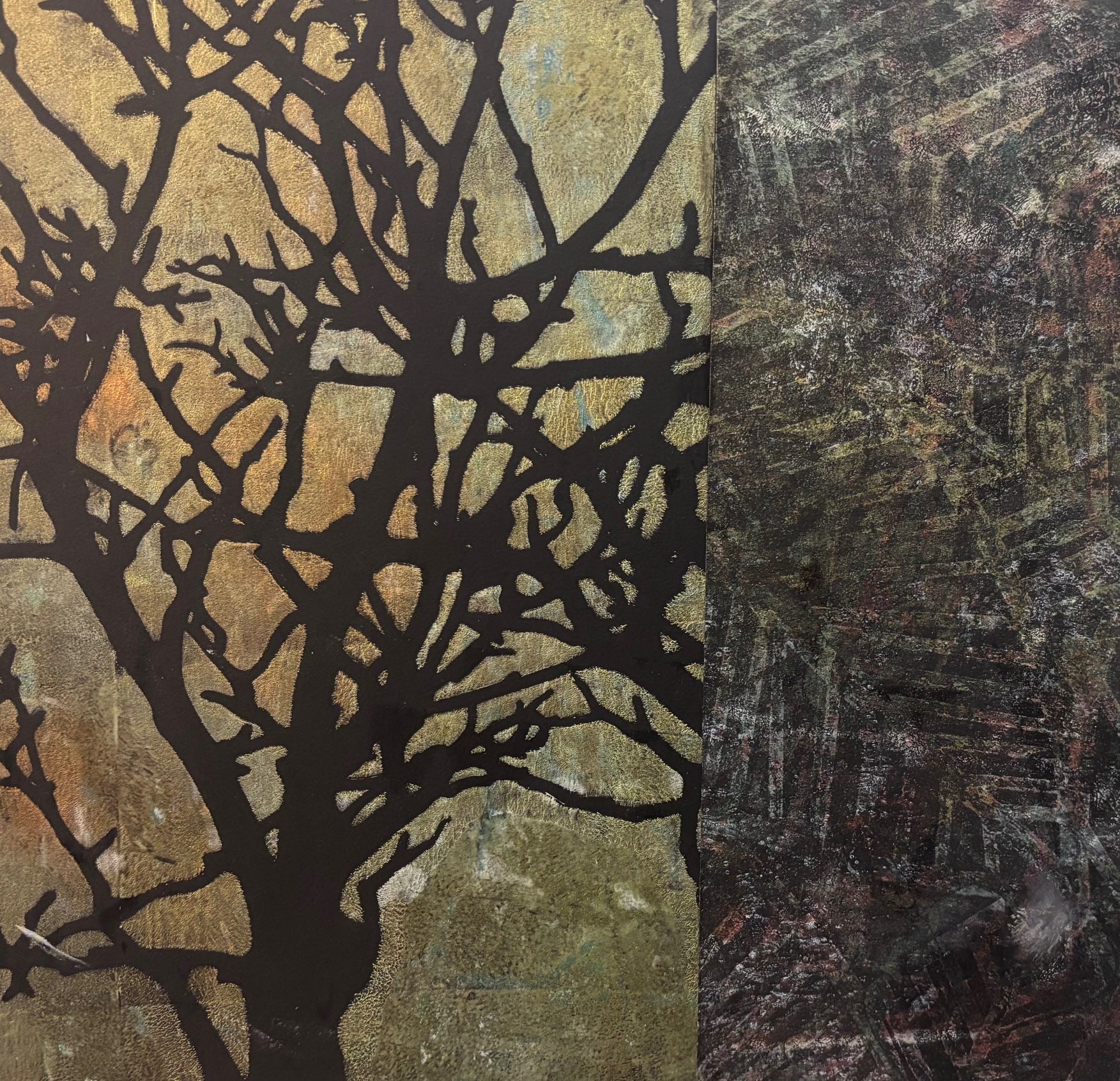
Promising
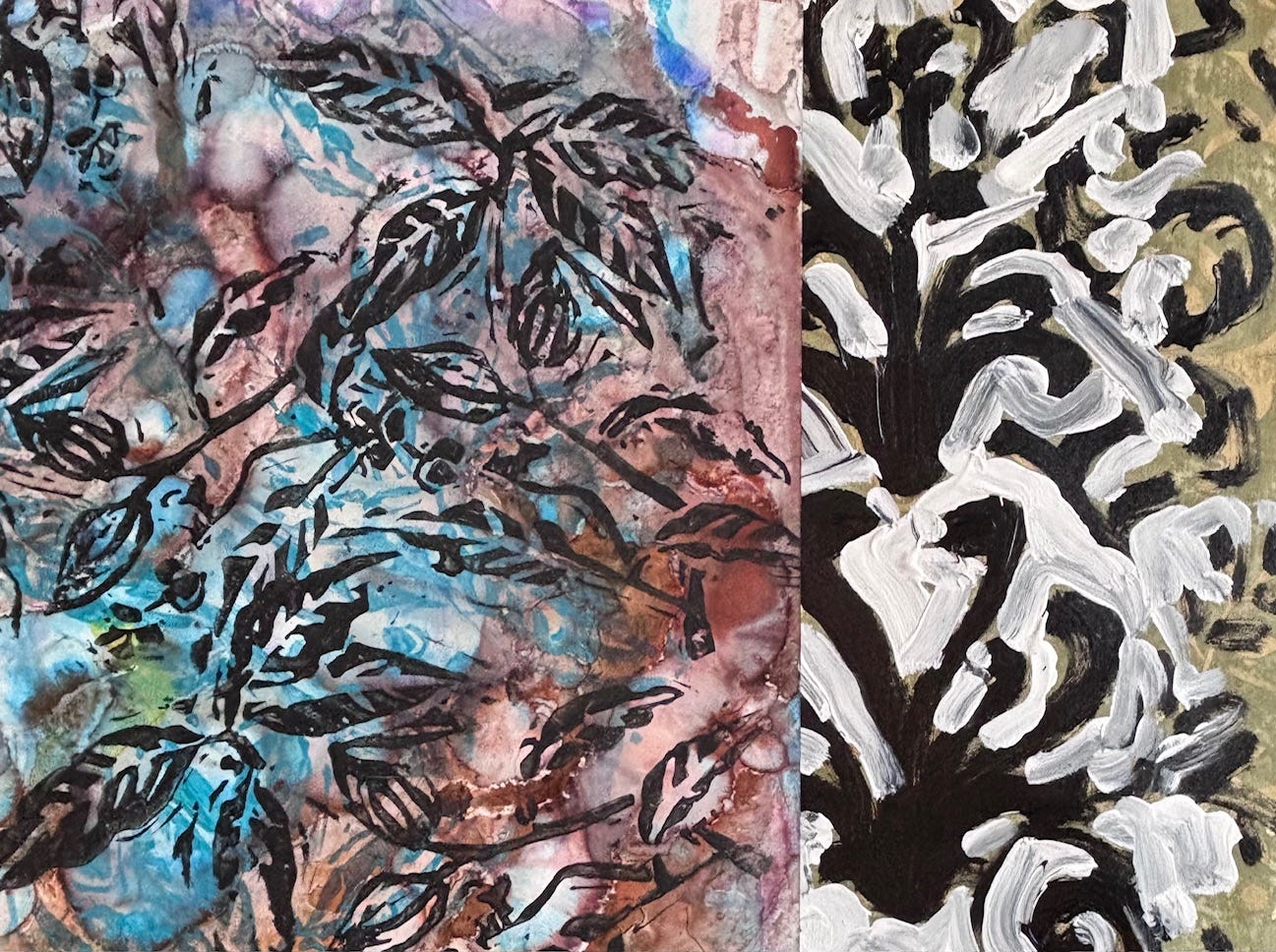
Pecan
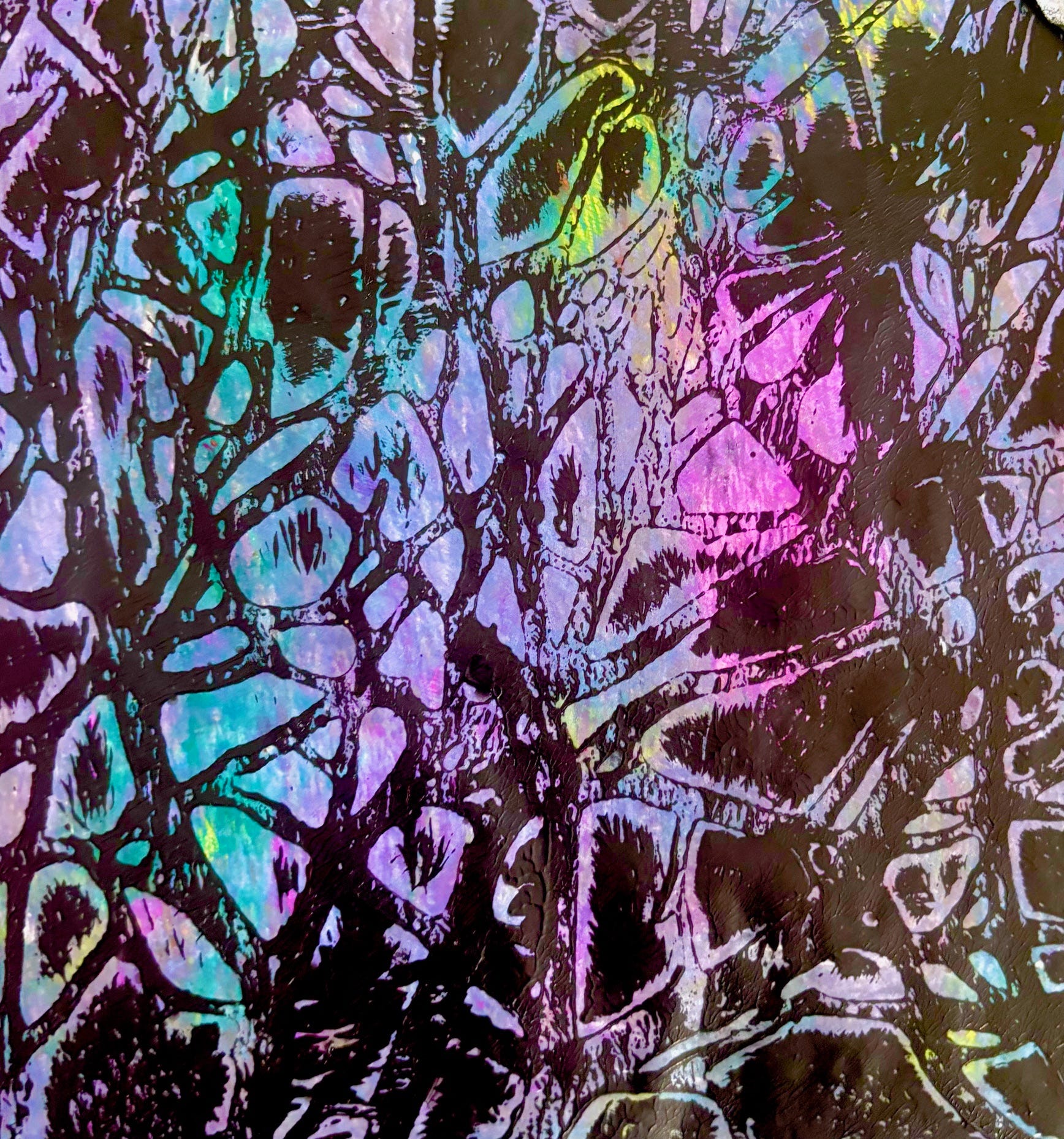
Find More of Cynthia’s Work at:
@cynthiayatchmanart on Instagram
Doug Stoiber
Doug Stoiber is a poet and short story writer, a member of Mossy Creek Writers in East Tennessee. Sixteen of his short stories and thirty-three of his poems have been published in magazines, journals and anthologies. His poem, "Nine Months Collage" has been shortlisted for The Poetry Lighthouse Prize, 2026.
Mission Accomplished, With Citation
Agent Desmond Pillifer (code name: Errand Boy) scanned the darkened entrance and
grounds of the Department’s secure intake facility, alert for the slightest movement. With the frozen serum vessel in a case secured to his left hand and wrist, he was going to have no more than ten seconds to leave his vehicle, traverse the laser field at the entrance, insert the chip key, and deliver the cryogenically frozen antidote behind the secure barrier door. And if he failed to gain entry within ten seconds, both he and the President of The United States would be dead.

He unlatched the transport hatch door and stepped out into the indigo night, switching on his thermal vision goggles as he did. ‘They’ were out there – somewhere between Agent Errand Boy and the facility portal – with a mission to eliminate him and extract the serum. He needed every advantage technology could give him. His nation’s freedom depended on it.

Ten seconds at most. Starting … NOW!

Desmond’s heartbeat and respiration, after years of intense training, remained normal,
even though his nervous system was on high alert. Using the transport as cover for the first ten yards, he stepped back around the vehicle rather than move straight toward the secret entrance.

So far, his vision field remained quiet, cool and motionless.

Nine. Four steps in the open – enough space for a sniper to take him out. But there were no thermal readings within effective firing range. A tense silence loomed as he reached the entrance to the laser field.

Eight. One careless move in negotiating the deadly laser field, and Desmond would not
draw another breath. With professional calm, he reviewed the exact sequence and placement of each step that he - and only he - knew, as he had been briefed for the mission. Left foot down on the concrete pad in precisely the vital spot, and he was on his way for the last fifteen yards.

Seven. His right foot turned out at ten degrees, eight inches ahead of his left toe, his
second successful step accomplished, when his night vision headset emitted a barely audible ‘click’. Bogie at 8 o’clock. ‘They’ were there and closing on him from behind his left shoulder.

Six. Quickly assessing their location and distance, Errand Boy calculated that his
remaining ten steps would allow him no more than four seconds to complete - and perfectly so - or he was a corpse. Dead before his body hit the concrete. And so too would be the President, soon after. Shuffling sideways as prescribed, he expertly and safely covered the next five yards.

Five. He was still up and moving, no shots fired. That indicated that they didn’t intend to eliminate him – at least not yet. They apparently wanted to capture both Errand Boy and the cryo-serum. That is, if they could somehow neutralize the laser field before he could reach the secure door and affect entry.

Four. Turning 180 degrees on his heels, Desmond hopped the next three yards in reverse, expertly so. His precision footwork was executed to perfection, and all while maintaining a heart rate of fifty beats per minute. No time to waste, the bright red heat fields were closing from both sides now, close enough to hear their breathing.

Three. Reversing again, Errand Boy faced forward and took the last two giant steps while crouched low with his arms held out at right angles from his body, the courier case with the frozen serum secured to his left wrist. They were within steps of reaching him – and the laser arrays. Did they know? Probably.

Two. Completing the last step successfully, the laser field now deactivated, (leaving
Errand Boy totally unprotected), just long enough for him to retrieve the chip key with his right hand and insert it into the Department’s secure access entrance. They were close enough now that he could feel the air pressure around him change. He would have only one chance to insert and activate the key and get safely inside the compound.

One. Desmond dodged attacks from both sides while calmly extracting the key and
inserting it in the magnetic reader. Executing a spinning right cross with his fist while swinging the courier case with his left, he made solid contact with both enemy agents simultaneously, just as he stepped through and secured the entry way, stunning the assailants just long enough for Errand Boy to slam the door.
Zero. Mission accomplished.

“Des? That you?”
“Yes, Hon.”
“Did you get the Moose Tracks?”
“They were all out, Hon. Got you Caramel Brownie Crunch instead.”
“You’re a sweetheart. Come here and get a big smooch.”

The End
John Grey
John Grey is an Australian poet, US resident, recently published in Shift, Trampoline and Flights. Latest books, “Bittersweet”, “Subject Matters” and “Between Two Fires” are available through Amazon. Work upcoming in Levitate, White Wall Review and Willow Review.
THE EYES OF THE MEN
I saw their eyes
in the aisles of the market,
hunger pinched to the bone
fingers dirty untrimmed
drifting like small thieves
along the dented rims of bargain bins.

Those dull eyes
told me
what lived behind them -
track‑marked shame
the slow burn
of wood‑grain liquor,
a couch,
a TV,
no work for years.

And I kept walking, pretending
I didn’t recognize the look.

And I thought about those eyes,—
how they’d go home with their cans
of almost‑food,
their cheap bottles,
their quiet rooms.

And how tomorrow
they’d be back again,
same aisle, same hunger,
same ghosts preying on their memories.

Hell, maybe I would too.
SELF-PUBLISHED
Her latest collection
will be called “Blood Poems”.
It’s self-published.
She even drew the front cover,
a sketch of a naked woman
with all of her veins showing.
On the back is the same photo
that she’s been peddling of herself
for the past twenty years.
It’s the Dorian Gray syndrome.
The picture grows no older.
But her poems age appropriately.
They sag. They wrinkle.
They start to smell.

She mails her book
in manila envelopes to reviewers
who won’t read past the first line
and to lovers who never
lasted past the first drink.
This is the racket.
But it’s also the art.
And, as the title says,
it really is the blood.
HUNTING CATALOGUE
A hunting catalogue
pops up in my mailbox.
The company really does need
to recheck their algorithms.

But I leaf through its glossy pages,
to get an idea of how expensive life would be
if I was someone else.

For example,
Polartec hat, fleecy sleepwear,
insulated parka, wool-lined boots,
and lots of camouflaged pants and jacket,
as if October in the woods really is a war.

No guns for sale.
I’d need a different catalog.
But you can’t beat night-vision goggles
if darkness is not your thing.
And telescopic sights
if your target’s on a different continent.

I toss it out
because there’s a deer looking over my shoulder.
I don’t want it getting ideas.
GEPHYROPHOBIA
He suffered from gephyrophobia,
the fear of tunnels.
And here he was,
travelling by train
through the Austrian alps,
a veritable hive of pockmarks
in seemingly every cliff-face.

He tried not to look ahead,
but the sudden whoosh
of darkness on all sides
sent his heart racing,
stomach dropping,
head spinning like a helicopter blade.

The other passengers had no worries
zipping through gouged-out gneiss.
They dozed.
They read books.
Or they ate their meals
at a relaxing pace in the dining car.

How he hated that feeling
when the world he knew
with all its sunshine and clarity
was, in an instant,
snatched away from him.

Where am I?
What’s happening to me?
The questions didn’t dissipate
even in the light.

Once free of the tunnel,
the train pulled into a station.
A sign read ‘You’re In Eissenwart.’
He stared at it for some time
but he wasn’t convinced.
IN THE MOMENTS AFTER SEX
I see a forest
and a white horse
and people…
but no one I know.

And there’s a path
with not one footprint,
and someone blowing a bugle
in the distance,
a spotless sky
and a herd of elk
walking in single file.

A clock keeps striking,
ribbons flutter through the air,
a gauze moon illuminates
an empty street
and rooftops of melting snow.

A clean shirt dries on a line.
A rack overflows with shoes.
A god sits atop a pole
and he looks just like my brother.

From the east,
migrants come.
From the south,
a blind man stumbles.

I sense no grief
but do hear some unfamiliar languages.
And every hill
has a far side
and a far side beyond that.

A stranger asks for my passport.
My parents reveal themselves
as nothing more than minute larvae.
And ropes dangle from tree branches,
skirt the surface of a lake.

Meanwhile, you merely fall asleep.
Somehow, the nothingness
doesn’t disturb you.
Souad Zakarani
Moroccan writer, poet & translator. Graduated with a Bachelor in French literature and English Linguistics, she worked as a foreign language teacher at a language institute in Casablanca. She currently works as a translator for a local newspaper and has poetry, narrative, and critical contributions in various local and international literary newspapers and magazines. Her works featured in several anthologies worldwide such as Poems for Rich, centenary Project, Oldham Poetry, Well Read, Hooligan Street, AVA the University of Vienna’s student magazine for comparative literature & culture the magazine / Sofón, / Romanian/Australian Anthology of Contemporary Poetry & Prose, / Morecambe Poetry Festival Anthology, and the anthology Zest of the Lemon volume 3. Her poem «Weiß» was shortlisted for the Ulrich GRASNICK Lyrikpreis 2025. Her poem “ Sauberer Erde “ third-placed in Friedrich Schiller International poetry Competition 2025 She is working on publishing her first poetry collection in German, in addition to her interest in translating Moroccan folktales into several languages.
So We Don’t Sleep
                  I’m afraid to close my eyes,
                                O mother,
 your eyelashes raise one question after another.
          There is a story in your eyes—speak it.
                  Words yawn on my tongue;
               they’ve lived there long enough.
                           Arise, O rubble,
                          Come out of me!
                    Perhaps I could breathe,
            with a body freed from shrouds.
         Can we tidy the house one last time
                    before we’re displaced?
         Can we photograph it for memory—
Store our laughter, our tears, and our screams—
                             then leave?
                   O sea stacked before us
                       like a shy embrace
                       in a world not ours,
     Can you send our echo to nearby oceans
 so a giant whale strikes the occupier’s base?
            Can we invent a new alphabet
               for fear, for pain, for home,
                     So the world hears
    That gray, continuous sound above us—
                       Buzzing planes,
                       Roaring rockets
               Above green, above ruin,
                   Above a gravestone
      Scrawled in charcoal on a burnt house,
                  The trace of a Firebolt?
  A thousand times, the eyes sip from the sky
            while we search for warmth
              to gently carry us to sleep
                    under our balcony,
        a seamless sleep that tickles the stars.
                     I want… to sleep.
        I dreamed of some leader speaking—
                 do you hear, mother?
       I see you laughing, feeding the birds.
   I see you playing on the swing of paradise,
Iridescent colors glowing in a rainbow slumber,
 Like a bottle shaken—dreams all mixed inside.
                 O mother, I swear I saw it:
               One shroud in Gaza holding
                the bodies of three martyrs.
           I became a worn, wounded body
                     groaning with pain.
      I want to hear the heartbeat of the sun—
            or the heart itself… that sponge
                   which has grown hard.
        That’s how we walk—on feathers—
       until we reach the peak of exhaustion
                 In full daylight and say:
                     We shall live here.
Olives of Gaza
                  Beyond the foreboding walls,
                    as the sunset begins to fall,
               a group of olive trees are swaying
normally, we would hear the sound of children playing.

                 But in this melancholic place,
       children no longer have smiles on their face
                   as the bombs begin to drop,
            all happy memories are soon forgot.

              And what is left, is a gaping hole,
                       where life once stood.
            Buildings may have been destroyed,
            but you cannot destroy Gaza's soul.

   For even though Gaza now is filled with sadness,
                    and moments of despair,
         the pride the people have in their land
         is something very much still in the air.

        And this is all thanks to the little olives,
          who have been swaying in the wind
     and who watch over Rafah, Khan Younis,
              Deir Al Balah, Jabalia and all
              Gaza's streets like guardians
       for they know it is not Gaza's people
        who are the ones who have sinned.

       So the olives sway in the wind all day,
so Gaza's children can once again play.Thank you for reading Adapt, Balestra’s Sixth Edition! This edition was a joy to assemble. Choosing which pieces to publish out of the dozens submitted is always a difficult task, and never more than for this edition. For that reason I want to give a special thanks to our guest poetry editors:
Amanda Hill
Amanda Hill is a Sydney born Irish writer, raised and well settled in Dublin. She is currently studying her MA in creative writing in UCD and taking a well earned break from her bill-paying career as a professional data wrangler.
Amanda has been published in Anansi Archives, Tales of the Unreal, and Sparks Literary Journal. Her current writing interest is climate fiction, with a nod towards her long held love for science fiction, fantasy, and magical realism.
&
Enorah El Houari
We hope you’ve enjoyed reading Adapt. If you did, leave a comment telling us what you’re favourite piece of work was, considering subscribing, and share Adapt with anyone else you know who would enjoyed reading it. Thank you for supporting Balestra, and stay with us to see more work from our ever-growing community of cutting edge contemporary artists.
If you would like to see even more Balestra, please check out our shop to pick up a copy of our Year One anthology or some custom designed Balestra merchandise.
Wishing you all the best,
The Balestra Team
Interesting poem. I especially liked your use of the senses. Your poem definitely paints a picture.